

Risk management is a critical concern in landscaping, municipal maintenance, and agricultural operations. Every day, workers face hazards ranging from steep, unstable slopes to fast-moving blades and flying debris-with these risks often translating directly into injury claims, lost workdays, and higher insurance premiums. The remote control lawn mower offers a fundamentally safer alternative by breaking the dangerous link between human operators and hazardous working environments, eliminating much of the physical exposure that has long defined the profession.
Common Operational Risks
Understanding the specific risks inherent in traditional mowing helps explain why remote-controlled solutions are gaining such rapid acceptance. The most frequent dangers include:
Slipping and Rollovers on Slopes – Slopes that exceed 20-30 degrees are treacherous for walk-behind and ride-on mowers. Operators may lose footing on wet grass, loose soil, or leaf litter, leading to falls that can pull them into the cutting deck. Even worse, ride-on machines can lose traction and roll sideways, pinning the operator beneath hundreds of kilograms of steel. Rollover accidents consistently rank among the most severe injuries in the landscaping industry.
Contact with Moving Blades – The cutting blades of a mower operate at high rotational speeds, typically 2,000-3,000 rpm or more. Contact with a blade-whether from a slip, a trip, reaching down to clear debris while the engine is running, or the machine unexpectedly lurching forward-can result in catastrophic lacerations or amputations. Many of these accidents occur not during active mowing but during clearing, adjustment, or restarting.
Exposure to Flying Debris – Mowers throw objects with surprising force: rocks, sticks, pieces of metal, and other debris can be ejected at speeds exceeding 100 km/h (60 mph). Operators positioned behind or on a traditional mower are directly in the line of fire. Eye injuries, broken bones, and even fatalities from projectile impacts are well-documented. Workers nearby-other crew members or bystanders-are also at risk.
Worker Fatigue Leading to Errors – Manual mowing is physically demanding. Over an eight-hour shift, an operator may walk many kilometers while pushing a heavy machine, or endure hours of vibration and noise on a ride-on mower. Fatigue sets in, concentration wanes, and the probability of mistakes-a slip on a slope, a misjudged turn, forgetting to disengage blades-increases dramatically. Fatigued workers are also more likely to skip safety checks or take shortcuts that lead to accidents.
How Remote Operation Mitigates Risks
Remote-controlled equipment fundamentally changes this risk profile by removing the operator from the danger zone. Key mitigation strategies include:
Maintaining a Safe Distance – The most direct safety benefit is simply keeping people away from harm's way. Using a handheld transmitter with typical ranges of 150 to 300 meters, an operator can position themselves on stable, dry ground-behind a guardrail, on a roadway shoulder, or inside a vehicle-while the machine works on the hazardous slope or beneath a solar array. This distance alone eliminates the risk of rollover injuries, blade contact, and most debris impacts.
Avoiding Hazardous Zones – In practice, this means operators no longer need to stand on the crest of a steep embankment, walk along the edge of a busy highway median, or navigate muddy irrigation ditches. The machine goes where it would be unsafe for a person to go. For municipal crews responsible for roadside vegetation, this completely changes the safety equation: the operator stays behind safety barriers or inside the cab of a truck while the mower handles the edge of the pavement.
Responding Quickly via Control Systems – Remote control is not merely about distance; it is about responsive, intuitive command. Modern systems use frequency-hopping spread spectrum (FHSS) technology to maintain a clean, interference-resistant signal. If the operator sees a hazard-an unexpected rock, a pedestrian approaching, a sudden change in slope-they can stop the machine instantly. The emergency stop button on the remote control cuts off engine power and blade rotation within milliseconds, far faster than any physical intervention could achieve.
Built-in Safety Features
Professional remote-controlled mowers incorporate multiple layers of safety engineering that go far beyond what traditional equipment offers:
Emergency Stop Systems – Every remote unit includes a prominently placed emergency stop button. When pressed, it immediately shuts down the engine and stops blade rotation. Importantly, these systems are designed to fail safe: if the remote loses signal, if batteries run low, or if interference disrupts communication, the machine automatically powers down and stops all moving parts. This "dead man's switch" principle ensures that loss of control does not mean loss of safety.
Signal Interruption Protection – Advanced remote systems continuously monitor signal integrity. If the connection between the transmitter and receiver weakens or is lost, the machine executes a pre-programmed safe shutdown within a fraction of a second. This prevents runaway operation-a critical feature when working near roads, buildings, or other people. Some systems also include geo-fencing capabilities, allowing operators to set virtual boundaries that the mower cannot cross.
Stability-Enhancing Designs – Manufacturers engineer remote-controlled mowers specifically for the conditions they will face. Low center of gravity, wide track or wheel stance, and balanced weight distribution all contribute to stability. Many tracked models can operate safely on slopes up to 45 degrees without tipping, something no ride-on mower can match. Tilt sensors provide real-time feedback to the operator, and some automatic systems will cut power and apply brakes if the machine exceeds its safe operating angle.
Additional Safety Considerations
Beyond the core features, several other design elements reduce risk:
Blade Brake Systems – When the operator releases the blade engagement control, the blades stop rotating within seconds-not while coasting to a halt. This reduces the risk of injury during clearing or repositioning.
Low Ground Pressure – Tracked models distribute weight over a larger area than wheeled machines, reducing the risk of rutting and, more importantly, making them far less likely to break through soft ground or undermine slopes.
Weather Sealing – Sealed electrical components and corrosion-resistant coatings ensure that safety systems function reliably even in wet or dusty conditions, where traditional machines might experience short circuits or control failures.
Reducing Accident Costs
The financial impact of workplace accidents extends far beyond direct medical expenses. When a worker is injured:
- Workers' compensation claims increase insurance premiums for years.
- Lost productivity from the injured worker's absence-and often from a second worker accompanying them to medical care or covering their duties-adds hidden costs.
- Equipment damage from rollovers or collisions requires expensive repairs.
- Regulatory fines may apply if safety violations are found.
- Reputational harm can cost future contracts, especially for commercial landscapers bidding on municipal or corporate work.
By dramatically reducing accident frequency and severity, remote-controlled mowing equipment helps businesses control these costs. Insurance carriers in some markets now offer premium discounts to contractors who adopt remote-controlled mowers for high-risk tasks such as slope mowing and roadside maintenance.
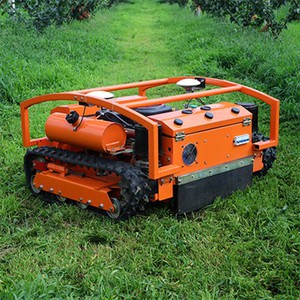
Chengfeng's Safety Engineering
Chengfeng Machinery integrates safety-focused design into every stage of production. From the initial chassis layout to the final software calibration, safety is not an afterthought but a primary engineering requirement. Key elements of Chengfeng's approach include:
- Robotic welding ensures consistent, high-strength frame construction with no weak points that could fail under stress.
- Sealed electronic components protect control systems from moisture, dust, and vibration-common causes of signal loss or erratic behavior.
- Rigorous pre-shipment testing includes tilt-table stability verification, signal range testing under simulated interference, and endurance runs that validate emergency stop functionality.
- Compliance with international standards ensures that Chengfeng machines meet CE (Europe) and other region-specific safety requirements, giving buyers confidence that the equipment has been independently evaluated.
This engineering rigor translates directly into operator safety. When a contractor deploys a Chengfeng machine on a steep highway embankment or a wet orchard slope, they can trust that the safety systems will perform as designed.
Real-World Impact: From Risk to Routine
Consider a typical municipal crew assigned to mow a highway median. With traditional equipment, workers must stand on the edge of active traffic lanes, watching for passing vehicles while operating a ride-on mower. The risk of being struck is constant. Weather exacerbates the danger: rain reduces visibility and makes the median slippery; heat causes fatigue and distraction.
With a remote-controlled mower, the same job becomes routine. The operator stands behind a concrete barrier or sits in the cab of a parked truck, controlling the mower from a safe position. The machine handles the slope and the proximity to traffic; the operator handles only the controls. Accidents that once required emergency room visits become events that simply do not happen.
FAQ
Q1: Are these machines safer than traditional ones?
Yes, especially in hazardous environments such as steep slopes, highway medians, and areas with flying debris. By eliminating operator exposure to these dangers, remote-controlled mowers fundamentally reduce the most common injury mechanisms in landscaping-rollovers, blade contact, and projectile impacts.
Q2: Do they reduce accidents?
Significantly. The primary accident vectors in traditional mowing all require an operator to be physically on or near the machine. Remote operation removes that requirement. While no equipment is completely accident-proof, users consistently report dramatic reductions in injury claims after switching to remote-controlled mowers.
Q3: Are safety features standard?
Most professional models include emergency stop systems, signal loss protection, and stability-enhancing designs as standard equipment. Buyers should verify that these features are included and that the manufacturer complies with relevant safety certifications.
Conclusion
For landscaping contractors, municipal agencies, and agricultural operators, operational risks are not abstract concerns-they are daily realities that affect worker well-being, insurance costs, and business sustainability. Adopting remote-controlled mowing equipment is an effective and proven way to reduce those risks while maintaining or even improving productivity. By keeping operators out of harm's way, these machines do not just protect people; they protect the businesses that depend on them.


